OLIVE: Joint Analysis and Synthesis for Self-Supervised Speech Representations

Karl El Hajal and Mathew Magimai-Doss

Motivation

Speaking Hearing

Hearing and speaking

Speech communication fundamentally arises from perception (hearing) and production (speaking).

Analysis Features Synthesis

Analysis–synthesis

Classical speech processing embraced this through the analysis–synthesis paradigm.

Atal and Hanauer 1971 · McAulay and Quatieri 1986
speech SSL Predictions

Speech SSL

Speech SSL learns representations for predictive tasks, without explicitly preserving signal detail for generation. Synthesis remains peripheral.

Can we train one representation that supports both analysis and synthesis?

Challenges

Reconstruction requires signal-level information such as speaker characteristics and fine-grained acoustic detail.

Discriminative SSL benefits from representations that abstract away such variability.

Existing approaches

data2vec-SG

Reconstruction is a lightly weighted auxiliary loss on the top contextual layers. The decoder is discarded after pre-training.

Wang et al. 2023

UniWav

Jointly trains an encoder and a generative decoder. Its main limitation is lower recognition performance than SSL models of similar scale.

Liu et al. 2025

Typical Speech SSL Model Architecture

Contextual representations Extracted features CNN feature extractor Raw speech waveform Transformer encoder

SSL Training Paradigms

Joint embedding

view 1 view 2 encoder encoder agree

Pull the embeddings of two views of the same input together, in embedding space.

Example: BYOL-A

Generative

input, partly masked encoder

Predict the hidden part of the input from the visible part.

Examples: wav2vec 2.0, HuBERT, WavLM

Joint embedding predictive

masked context encoder predictor predicted embedding full target input target encoder target embedding

Predict the embedding of the hidden part from the visible part, in embedding space.

Examples: WavJEPA, data2vec

OLIVE combines masked latent prediction and waveform reconstruction

x a″ a′ teacher view x″ student view x′ local feature extractor teacher features student features analysis: masked distillation mask teacher encoder student encoder EMA predictor teacher targets stop gradient ℒ analysis synthesis: waveform reconstruction neural vocoder x̂′ ℒ synthesis x′ ℒ OLIVE λsynthesis

Functional Separation

Contextual Feature Extractor Local Feature Extractor waveform
Synthesis encourages early features to maintain signal-level detail.
Analysis shapes the later layers.
Both objectives share one encoder and one pre-training stage.

Experimental Setup

Pre-training

  • LibriSpeech: 960 h
  • 93.8M-parameter encoder
  • 7-layer CNN and 12-layer Transformer
  • 400k updates

Waveform augmentations

Reference

Mel spectrogram of the LibriSpeech reference excerpt

Mixup: blend another speech excerpt.

Mel spectrogram after mixing another speech excerpt

Gain: change amplitude.

Mel spectrogram after gain augmentation, on the same dB scale

Augmentations such as pitch shifting and time stretching were avoided to preserve speaker identity and prosody.

Trained models

OLIVE-A (Mix)

Analysis with mixup

OLIVE-A (Mix+Gain)

Analysis with mixup and gain

OLIVE-J (Mask-only)

Analysis and synthesis, without waveform augmentation

OLIVE-J (Mix)

Analysis and synthesis with mixup

Evaluation

Baselines

Matched model size and training data.
Only pre-training objectives differ

Base-sized SSL models trained on LibriSpeech 960 h:

  • wav2vec 2.0
  • HuBERT
  • WavLM
  • data2vec
  • data2vec 2.0

Acoustic reference: FBANK.

Downstream tasks

SUPERB evaluates frozen SSL models as general-purpose feature extractors.

For each task, a learned weighted sum of all encoder layers is fed to a lightweight task head.

  • Content: speech recognition, keyword spotting
  • Speaker: identification, verification, diarization
  • Paralinguistic: emotion recognition
  • Semantic: intent classification, slot filling, speech translation
  • Generation: speech enhancement, source separation, voice conversion

Waveform reconstruction

Train the same HiFi-GAN V2 on each model's frozen local features.

Evaluate on LibriSpeech test-clean.

Also evaluate each OLIVE-J model's integrated vocoder.

  • Quality: PESQ, ViSQOL, UTMOS
  • Intelligibility: STOI, WER
  • Speaker similarity: SECS
  • Spectral fidelity: Mel-L1, LSD, MCD
  • Pitch: F₀ MAE
  • Signal fidelity: SI-SDR, SNR

Results: SUPERB Tasks

WavLMs(u)=1|T|∑t∈Ts~t(u)

T: tasks; s̃ₜ: normalized task utility.

data2vec 2.0OLIVE-J (Mask-only)OLIVE-A (Mix)OLIVE-J (Mix) + reconstruction + mixup

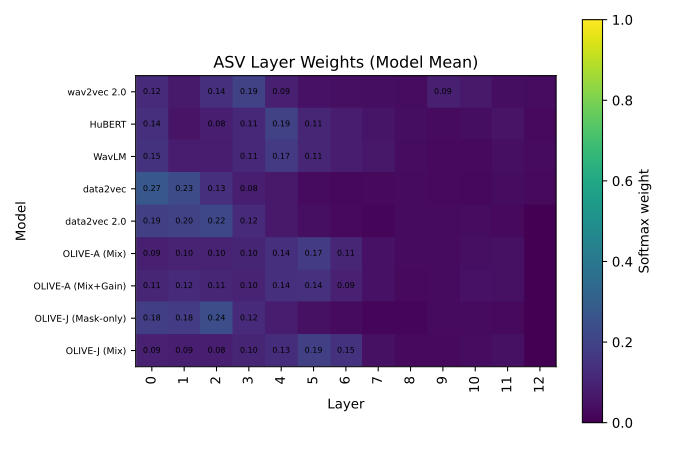
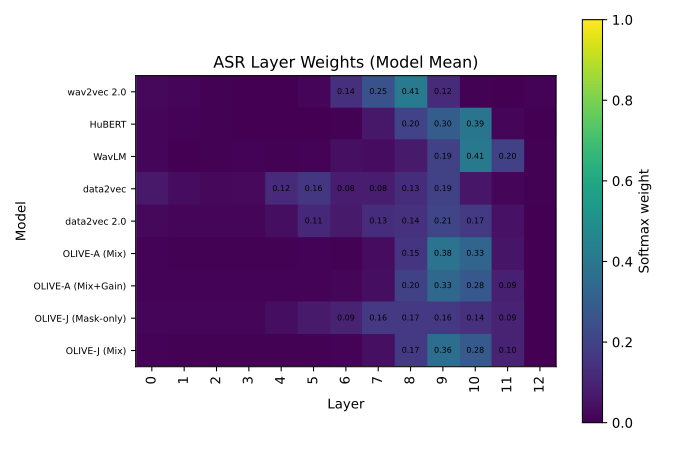
Learned layer weights: speech recognition uses later layers, speaker verification earlier layers
ASR layer weights ASV layer weights

Learned SUPERB layer weights (softmax), averaged per model. Layer 0 = local CNN features.

Results: Waveform Reconstruction

Conclusions

Reconstruction on early features and masked prediction on later ones can be trained together in a single pre-training stage.
Reconstruction improves resynthesis and speaker information; recognition stays close to data2vec 2.0.
Waveform augmentations shift the representation toward speaker and generation tasks, at a small recognition cost.
The vocoder is kept after pre-training and reconstructs waveforms.

Limitations

  • English only
  • LibriSpeech 960 h, read speech
  • Base size only